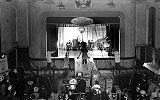




The program begins by looking at some of the earliest arrivals on our planet with babies born around the world starting with Japan at 4:04am, then Denmark one hour before sunset at 8:06pm, next its 1:06pm in Mexico City, then 3,000 miles to the north at Edmonton in Canada where a Cree Indian baby is born, only four of some 1,800 born in the short time since the program began. … Participating broadcasting organisations included: Australian Broadcasting Commission (ABC) Austrian Broadcasting Corporation (ORF) British Broadcasting Corporation (BBC1) Canadian Broadcasting Corporation (CBC) NHK (Japan) National Educational Television (NET) (USA) Office de Radiodiffusion Télévision Française (ORTF) (France) Radiotelevisione Italiana (RAI)(Italy) Televisión Española (TVE) (Spain) Some of the locations included: Abbey Road Studios, London, UK (Beatles’ segment) Glassboro, New Jersey, USA Parkes, New South Wales, Australia Melbourne, Victoria, Australia Tokyo, Japan Toronto, Ontario, Canada Owing to language issues for Australians, interpreters translated the foreign commentaries for Australian Broadcasting Commission (ABC) announcers to provide an English voice-over where necessary.
You're viewing Technology
The Evolution of Television News and Presentation
TVW-7 News readers over the decades 1950’s Geoff Walker, David Farr, Lloyd Lawson and Phillip Edgely 1960’s David Farr, Lloyd Lawson, Gary Carvolth, Garry Meadows, Pam Leuba, Eric Walters, John Chalton, Bill Gill, Brien Thirley, Marcus Hale, David Low and Terry Willesee 1970’s Peter Waltham, Neil Watson, Russell Goodrick, Greg Pearce, David Ellery, Peter Newman, Rick Ardon and Terry Willesee 1980’s Rick Ardon, Susannah Carr, Jeff Newman, Yvette Mooney, Steve Taylor, Dick Tombs, Paula Voce, Reece Whitby and Jeff Newman 1990’s Rick Ardon, Susannah Carr and Yvette Mooney 2000’s Rick Ardon, Susannah Carr, Yvette Mooney, Sally Bowrey, Emmy Kubainski and Samantha Jolly ABW-2 News readers over the decades 1960’s James Fisher, Ian Beatty, Earl Reeve, Clive Hale, Peter Harrison, Jeff Jeffery, Michael Palmer, John Harper-Nelson and George Manning 1970’s Earl Reeve, David Hawkes, Peter Harrison, John Harper-Nelson, Peter Holland, Dave Ellery, Peter Newman, George Manning, Eion Cameron and Murray Jennings 1980’s David Hawkes, Peter Holland, Anne Conti, Robyn Johnson and Ruth Walker 1990’s Peter Holland, Deborah Knight and Deborah Kennedy 2000’s Deborah Kennedy, Tom Baddeley, Paul Lockyer, Alicia Gorey, Craig Smart and Karina Carvalho STW-9 News readers over the decades 1960’s Walter Pym (Opening Night), Alan Graham, Jeff Newman, Lloyd Lawson, Peter Dean and Trevor Sutton 1970’s Peter Barlow, Neil Watson, and Russell Goodrick 1980’s Greg Pearce, Russell Goodrick, Valerie Davies, Anne Conti and Peter Waltham 1990’s Peter Waltham, Christine Parker, Liam Bartlett, Mikayla Turner, Tina Altieri, Terry Willesee, Peter Holland and Tina Altieri 2000’s Peter Holland, Dixie Marshall, Sonia Vinci, Greg Pearce and Dixie Marshall NEW-10 News readers over the decades 1980’s Greg Pearce and Gina Pickering 1990’s Greg Pearce, Claudia Saenz, Rachel McNally, Mikayla Turner and Christina Morrissey 2000’s Greg Pearce and Christina Morrissey, Celina Edmonds, Ron Wilson, Tim Webster and Charmaine Dragun (via Sydney) 2008 Narelda Jacobs (moved back to Perth) 2011 Craig Smart and Narelda Jacobs WA Television News Origins and Evolution
…MediaHub Australia is a multi-million dollar state-of-the-art facility in Ingleburn in Sydney’s South West which will be the central location for broadcasting both WIN and ABC content to all of Australia.
What is the future of Australian Television?
We take a look in the crystal ball to see where the television industry is heading. The Australian ABC’s Jonathan Holmes and the Media Watch team did the same in 2008, and a number of their findings are still relevant today.
Future of Australian TV
WA TV History
Veterans who worked in the television [...]
Can Free-to-air stations stay relevant as technology and audience needs change?
The Seven Network is now rolling out a wireless broadband network across Australia
The use of mobile broadband is growing quickly, driven by consumers powered with smartphones and connected laptops.
According to market researcher Telsyte, Australia’s consumer mobile broadband spending will double from $160 million in 2008 to $320 million in 2012.It’s very competative with the telecommunications companies busy selling internet-enabled USB keys to connect subscribers to the web [...]
How and why there is piracy of popular content.
Historical Aspect
Our cinemas and television stations are experiencing challenges never encountered fifty years ago. There was a considerable lag between a movie being seen in the US and in a Perth cinema during the 1950s. The movies shown in the suburban cinemas could be years behind the US first release date. The same was often [...]
The information and entertainment world is in a state of flux
Is there an unrealistic trend today where people expect things free through the internet? Or is there something fundamentally flawed with our information and entertainment business model, in this rapidly changing world?
The newspapers wish to introduce a fee for reading their publications on line at a time when internet users have an expectation that content [...]
World changing technology…
When TV began in WA the equipment was primitive by today’s standards. Almost everything was thermionic valve driven, bulky, power hungry and in constant need of adjustment and a higher maintenance risk. Each time TVW took the PYE image orthicon cameras out on an outside broadcast there was a high likelihood of component faults. TVW’s [...]
Ongoing Media Challenges
The media is constantly undergoing transition ever since the invention of paper and the Gothenburg printing press took over from monks in an abbey, each working with ink, paint, brush and pen. This was an important first step towards the democratisation of knowledge.
The invention of photography, the telegraph, telephone, motion pictures, radio, television, satellites, computers [...]